



Numerous fields of cancer research – especially basic research – require high-quality, well-annotated tumor material. This is what PATH offers. We make the tumor material available to researchers to support and accelerate progress in breast cancer research.
Usually, scientists cannot afford to set up and operate their own tissue banks. Especially smaller research groups are often unable to implement such a time-consuming and financially complex project. At PATH, we want to support and accelerate advances in cancer research by providing this infrastructure.
Together with our collaborating clinics, we have implemented clearly defined quality standards for processing the samples. All cooperation partners adhere strictly to these standard operating procedures. This allows us to ensure that all sample material from PATH is obtained and processed uniformly.
The tumor tissue removed during breast surgery is divided into equal parts (aliquots) immediately after routine diagnostics and frozen at temperatures of -150°C. Storing the samples at these very low temperatures ensures high sample quality, as shown in a study on RNA quality (Babel et al., Scientific Reports, 2020, see list of publications).
The biobank of the PATH Foundation currently contains biomaterial and data sets of about 13,000 breast cancer patients. That is a total of more than 34,000 samples, of the following types:
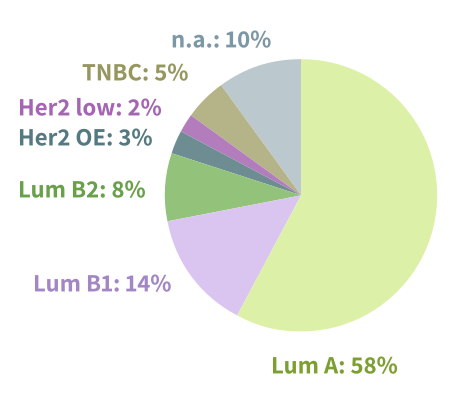
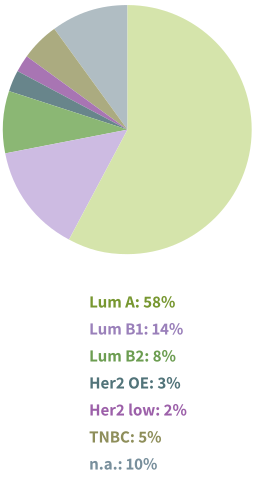
All molecular breast cancer subtypes are available at PATH biobank. The distribution can be seen in the pie chart. Tumor grading was used as a surrogate marker for Ki-67 expression in older samples.
The following data are documented in pseudonymized form for all samples:
A special feature of PATH’s range of services is the additional collection of real-world data: We regularly ask the PATH women who donated their tissue for disease-relevant information (follow-up). This allows us to continuously update patient data, e.g. on the course of the disease and therapy.

The PATH biobank enables us to specifically draw on special clinical constellations – including rare samples that are otherwise hardly available.
Dr. Verena Thewes, Head Precision Oncology Trials & Project Management Breast Cancer at NCT/DKFZ Heidelberg
Are you interested in high-quality breast cancer tissue and annotated datasets for your research? – Here you can download the application form:
The support of PATH was key for our publication in “Cell” and with their help, we engaged in several follow-up projects.
Prof. Dr. Bernd Bodenmiller, Director, Department of Quantitative Biomedicine, University of Zurich
Since the Biobank was founded, PATH has supported almost 50 scientific projects of university and public research institutions as well as industry with a wide range of samples and data. The topics are diverse:
The resulting scientific publications are available for download here:

PATH maintains a high level of professionalism and engagement, proving themselves to be a valuable partner in research.
Prof. Karolina Palucka, MD, PhD, Associate Director for Cancer Immunology, Jackson Lab, USA
“The PATH Biobank is a highly professional partner for us in translational cancer research. It not only gives us access to excellently annotated, high-quality breast cancer biomaterial, but also the rare opportunity to make targeted use of special clinical constellations – including rare samples that are otherwise hardly available. Our partnership with PATH is characterized by a high level of reliability, scientific understanding and an always solution-oriented exchange. This collaboration is invaluable for our work at the NCT / DKFZ Heidelberg.”
Dr. Verena Thewes, Head Precision Oncology Trials & Project Management Breast Cancer at NCT/DKFZ Heidelberg
Deutsches Krebsforschungszentrum (DKFZ), Heidelberg
Prof. Dr. Peter Lichter, Dr. Verena Thewes
A rare collective of 18 fresh frozen sample pairs, primary tumor and recurrence under tamoxifen (antiestrogen) therapy, was handed over to the group of Prof. Lichter from the DKFZ, Heidelberg. Verena Thewes was able to show a strong expression of the enzyme BCAT1 (branched-chain amino acid transaminase 1) in antiestrogen-resistant cells by qT-PCR measurements of the samples. The systematic analysis of BCAT1 in vitro and in vivo indicates an involvement of BCAT1 in the growth of antiestrogen-resistant and estrogen receptor-negative breast tumors. In addition, an association between high BCAT1 expression and an increased level of the proliferation marker Ki-67 was observed, suggesting a pro-proliferative role of BCAT1 in breast cancer. High BCAT1 levels are associated with reduced relapse-free survival in patients on adjuvant tamoxifen therapy and reduced overall survival. (Thewes et al., Oncogene (2017), 1–11).
“The patient-founded PATH biobank is a partner one can truly trust and built on. PATH organized for us the collection of breast tumor samples for single cell analysis. They planned and organized all biobanking efforts in a highly professional manner, and ensured the steady collection of top-quality samples over many years. PATH also supported us in legal aspects and to this day, keep the patient data up to date. This support of PATH was key for our publication in Cell and with their help, we engaged in several follow-up projects.”
Prof. Dr. Bernd Bodenmiller, Director of the Department of Quantitative Biomedicine, University of Zurich & Associate Professor of Quantitative Biomedicine, ETH Zurich
Bodenmiller Lab, University of Zurich
Prof. Dr. Bernd Bodenmiller
The research group of Prof. Dr. Bernd Bodenmiller at the University of Zurich has been cooperating with PATH for many years.
Tumor cells and associated healthy cells form ecosystems that determine disease progression and response to therapy. To characterize features of breast cancer ecosystems and their associations with clinical data, we analyzed 144 human breast tumor and 50 nontumor tissue samples, many provided by PATH, using mass cytometry. The expression of 73 proteins in 26 million cells was evaluated using tumor and immune cell-centric antibody panels. Tumors displayed individuality in tumor cell composition, including phenotypic abnormalities and phenotype dominance. Relationship analyses between tumor and immune cells revealed characteristics of ecosystems related to immunosuppression and poor prognosis. High frequencies of PDL1+ tumor-associated macrophages and exhausted T cells were found in high-grade ER+ and ER- tumors. (Wagner et al., 2019, Cell 177, 1330–1345).
BioNTech
Dr. Michael Oed und Dr. Mark Laible
The mRNA expression of ESR1/ER, PGR/PR, ERBB2/HER2 and MKI67/Ki67 was examined from 322 FFPE samples using RT-qPCR. With the help of the detailed PATH follow-up data, a Kaplan Meier analysis could be carried out. It was found that after a median follow-up time of 7.8 years, women from the group with “Luminal A-like” tumors reported significantly more frequent distant metastasis-free survival compared to women whose tumors were grouped differently, which were predominantly “Luminal B-like” tumors.
Women whose disease was classified as “Luminal A-like” by RT-qPCR were much less likely to experience distant metastasis in the 10-year period after diagnosis. (Laible et al. BMC Cancer (2019) 19:694)
Epidemiologie Uniklinik Schleswig-Holstein
PD Dr. Annika Waldmann, Institut für Sozialmedizin und Epidemiologie
Epidemiological question: Are older women treated in accordance with guidelines? – The “S3 Evidence-based Guideline for the Early Detection, Diagnosis, Treatment and Follow-up of Breast Cancer” states that in the therapy decision making process of doctor and patient the age of the patient must be considered when discussing treatment options, benefits and risks.
The question of age-group-specific differences in the treatment of breast cancer was investigated by Annika Waldmann's research group. In a retrospective analysis, the follow-up data of over 3,000 women with invasive primary tumor without distant metastasis were examined. There was a significant age-dependence for self-reported therapeutic measures. Older women (>69 years) were significantly less likely to undergo breast-conserving surgery and were significantly less likely to receive chemotherapy, radiotherapy and targeted treatments (AHT and trastuzumab) than patients in the younger age groups (<50; 50-69 years). The reasons for this remained unclear on the basis of the present evaluation. (Peters et al., Dtsch Ärztebk Int, 2015; 112:577-84)
“PATH Biobank, and biobanking in general, was instrumental in the successful retrospective validation of our Multiplex8+ breast cancer test. Access to clinical samples remains challenging for startups due to the siloes that big pharma and elite academic groups construct, which is why MultiplexDX enthusiastically supports the mission of biobanks to provide high quality samples with meticulously annotated clinical data so that all scientific researchers can advance our common fight against cancer.”
Evan Paul, PhD, Chief Scientific Officer, MulitplexDX
MultiplexDX, Bratislava
Evan Paul, PhD, Chief Scientific Officer
PATH biobank supported MultiplexDX with 715 FFPE tumor samples. The study introduces a mFISHseq platform, a groundbreaking approach that combines RNA-FISH with RNA sequencing, guided by laser capture microdissection. This method ensures tumor purity and unbiased transcriptome profiling while addressing critical challenges like intratumoral heterogeneity. In a study of 1,082 breast tissue samples, mFISHseq demonstrated 93% accuracy compared to IHC and identified biomarkers predictive of responses to targeted therapies, including antibody-drug conjugates and immunotherapies. (Paul et al., Nature Communications, 2025; 16:226).